RSU vesting taxation — the tech worker's tax survival guide
How RSUs get taxed at vesting (ordinary income) and at sale (capital gains), the under-withholding trap, and the planning math that saves $5K-$30K per year.
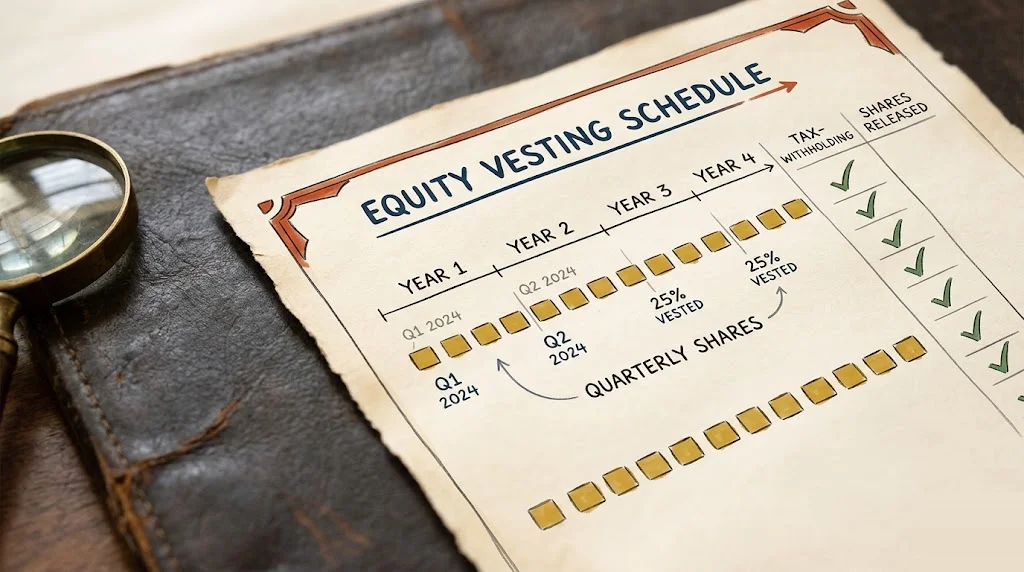
For a US tech worker (or any employee receiving Restricted Stock Units as compensation), the tax mechanics of RSU vesting are one of the largest tax-planning surfaces in personal finance. The vesting event triggers ordinary income tax at marginal rates on the full vested value — frequently producing a 4-6 figure tax liability per vest. The default employer withholding is typically inadequate to cover the tax, leaving a substantial bill at filing time that surprises first-time RSU recipients. Beyond the immediate tax event, the post-vest holding decision (sell immediately vs hold for long-term gains) determines whether the household ends up with a concentrated position in their employer’s stock — typically inadvisable from a portfolio diversification standpoint.
This guide walks through the mechanics of RSU taxation at vesting, the under-withholding trap that catches most first-time RSU recipients, the sell-vs-hold decision framework, the interaction with concentrated-position risk, and the planning protocol that converts the chaotic vesting event into a structured tax + investment workflow.
The two taxable events: vest and sale
RSUs are NOT taxed at grant. The grant is a promise of future shares conditional on continued employment through the vest date; no income is recognized until the condition is met (the vest happens). If you leave the company before vesting, you forfeit the unvested RSUs and no tax has been paid.
At vesting, the fair market value of the newly vested shares is added to your W-2 as ordinary income for the year. If 1,000 shares vest on March 15 when the stock is at $50, you have $50,000 of ordinary income added to your W-2 for the year of vesting. This is taxed at your marginal rate just like cash salary — typically 22%, 24%, 32%, or higher federal, plus state, plus FICA (Social Security up to the wage base + Medicare). The employer reports the value on your W-2 in Box 1 (wages) AND withholds tax by selling enough of the vested shares to cover the withholding. The default “sell to cover” approach typically leaves you with 65-78% of the vested shares (the remainder having been sold for withholding).
At sale, any difference between the sale price and the vest-day price is taxed as capital gain or loss under the standard short-term versus long-term capital gains rules:
- Short-term capital gain/loss (held <1 year from vest): taxed at ordinary income rates
- Long-term capital gain/loss (held >1 year from vest): taxed at preferential rates (0%, 15%, or 20% depending on income)
The vest-day price is your cost basis: it is the amount your employer added to Box 1 of your W-2 for the year. RSUs have no dedicated IRS information form (Form 3921 covers incentive stock options and Form 3922 covers employee stock purchase plans), so the basis shows up reliably only on your pay stub or your equity platform’s release confirmation, not on an IRS form. Some 1099-B forms historically reported $0 basis (an error) — always verify the reported basis matches the vest-day price on your year-end 1099-B and the W-2 reported vesting value. Incorrect basis means double-taxation at sale.
The under-withholding trap
The default RSU withholding rate is the federal “supplemental wage” rate of 22% (per IRS Publication 15 / Section 4.4). For employees earning above $1 million in supplemental wages in a calendar year, the rate jumps to 37%. For employees in lower brackets, the 22% default may be reasonable. For high-earning tech workers in the 24-37% marginal brackets, 22% is meaningful under-withholding on every vest.
Example: a tech worker earning $200,000 base salary + $100,000 of RSU vesting in a calendar year:
- Combined income: $300,000 (filed single)
- Federal marginal bracket: 35% on the portion above $256,225 (2026 single-filer threshold)
- Federal effective rate: roughly 24% on the $100K RSU portion alone
- Plus Additional Medicare Tax 0.9% above $200K = $900 on the RSU portion
- Plus state tax (if applicable) — California 9.3% = $9,300 on the RSU
Actual federal + Medicare owed on the $100K RSU: roughly $25,000. Employer withheld via supplemental rate: $22,000. Shortfall: $3,000.
This shortfall persists every year for every vest, growing as the employee’s income climbs. For a senior engineer with $400K+ RSU vesting per year, the shortfall can be $30,000+.
Three remediation paths:
Path 1: Adjust W-4 Step 4(c) — extra withholding. Calculate the expected shortfall and divide by remaining pay periods. Add that amount to Step 4(c) on a fresh W-4 submitted to your employer. The amount comes out of every regular paycheck as additional federal withholding. Simple, calibrates over time.
Path 2: Pay quarterly estimated tax. Use Form 1040-ES to pay the shortfall in four quarterly installments. Standard for self-employed; less common for W-2 workers but available. Adds a layer of admin but avoids tying up cash before the vest happens.
Path 3: Increase RSU-specific withholding (where employer allows). Some employers let you elect a higher withholding rate on RSU vesting specifically (e.g., 35% instead of 22%). This adjusts only the RSU vest withholding, not your regular paycheck. Check with HR if available.
For most tech workers, Path 1 (W-4 extra withholding) is the cleanest. The IRS Tax Withholding Estimator at irs.gov/individuals/tax-withholding-estimator computes the right Step 4(c) amount for your specific situation.
Sell-vs-hold at vesting
Once the shares vest, you own them outright (subject to any company-specific lockup or trading-window restrictions). The decision: sell immediately, or hold for potential appreciation?
The case for sell immediately:
- You have already paid ordinary income tax on the full vest-day value. Holding does not save tax.
- Selling at the vest-day price produces $0 capital gain (basis = sale price = $50). No additional tax event.
- Concentrating wealth in your employer’s stock is a structural risk — your salary, RSU vesting, and stock holding all depend on one company. A company-specific event (layoff, stock decline) hits you on all three axes simultaneously. If some of that employer stock sits inside a 401(k) rather than a brokerage account, a separate tax break — net unrealized appreciation — can apply when it comes out.
- The proceeds can be diversified into broad-market index funds, your IRA / Roth IRA contribution, your savings rate, or any other financial goal.
The case for hold:
- If the stock appreciates over the next year+, you pay long-term capital gains rates (0/15/20%) on the appreciation rather than ordinary rates (22-37%).
- For employees with strong conviction about their company’s prospects (often disputed in financial planning literature), holding can compound.
- Some employees can’t sell due to lockup periods or trading windows (insider trading rules apply to executives and certain roles).
The financial-planning consensus for typical employees: sell immediately by default. The diversification value typically exceeds the rate-arbitrage value of holding for long-term gains. Set up automatic sell-on-vest at the brokerage that holds your RSUs (E*TRADE Equity Edge, Schwab Stock Plan Services, Fidelity NetBenefits, Morgan Stanley StockPlan Connect — depending on your employer’s choice) and the decision is removed from your monthly attention.
If you do hold, set a rebalance trigger: “if my employer stock exceeds X% of my net worth, I sell down to Y%”. Common thresholds: don’t let any single stock exceed 10-15% of net worth. For tech workers with substantial RSU vesting at a single employer, this often means selling regularly even if you “believe in the company”.
State tax wrinkles for high-tax states
States that tax wages also tax RSU vesting at the state level — at the state’s ordinary income rates. California is the canonical example: a $100,000 RSU vest produces $9,300 of California state tax on top of federal. Texas, Florida, Nevada, Washington, Tennessee, and other no-state-income-tax states owe $0 state tax.
For employees who move between states during a vesting period (e.g., relocated from CA to TX mid-vest), the tax sourcing is allocated by the days of service in each state during the vest period — not by where you live on vest day. California aggressively asserts taxing rights on RSU vesting attributable to service performed in California, even if the employee moved before vest. Document your move dates and consult a CPA familiar with multistate RSU sourcing if you relocated during a vest period.
Tax-loss harvesting interaction
If your employer stock declines below the vest-day price by the time you sell, you have a capital loss. The loss interacts with tax-loss harvesting strategy:
- Long-term loss (held >1 year): offsets long-term gains, then short-term, then up to $3,000/year of ordinary income
- Short-term loss (held <1 year): offsets short-term gains, then long-term, then up to $3,000/year of ordinary income
For tech workers in stock-declining cycles, accumulated RSU losses can shield substantial capital gains from other holdings. See our tax-loss harvesting guide for the strategy details.
The planning protocol
For a tech worker receiving RSU compensation:
Annually (each January):
- Forecast expected RSU vesting for the year (from grants outstanding × vest schedule).
- Run IRS Withholding Estimator including the expected RSU income.
- Adjust W-4 Step 4(c) for the additional withholding needed beyond the 22% supplemental.
At each vest (typically quarterly):
- Confirm the vest amount on your equity portal.
- Verify employer “sell to cover” took the expected number of shares.
- If using automatic sell, confirm the sale completed at near-vest-price.
- If holding, set a calendar reminder for the 1-year mark to evaluate long-term-vs-short-term decision.
Annually (year-end):
- Verify 1099-B basis matches W-2 reported vesting + correct vest-day price.
- File any necessary tax-loss harvesting moves if applicable.
- Re-forecast next year’s vesting and adjust W-4 if income picture changed.
At sale (whenever):
- Identify the specific lot being sold (specific identification typically gives best control).
- Verify cost basis with the brokerage.
- Track for Schedule D reporting.
What this guide does not cover
This guide focused on US-employee RSU taxation under standard W-2 wage structure. It does not cover:
- ISOs (Incentive Stock Options) — different tax mechanism with AMT implications.
- NSOs / NQSOs (Non-qualified Stock Options) — closer to RSU but different timing of taxable event.
- ESPP (Employee Stock Purchase Plans) — discount-based purchase with separate tax treatment.
- Section 83(b) elections for early-vest equity — applies to restricted stock, not RSUs typically.
- Equity comp at private companies — RSUs at pre-IPO companies have additional complexity around vesting + liquidity windows.
- Cross-border tax issues for non-US-resident employees of US companies.
For US W-2 employees receiving standard RSU compensation at a public company, the framework above is complete.
What to verify
- W-2 (Box 1 includes the vest value), the equity platform’s release confirmations, and the 1099-B from your equity brokerage for basis reporting
- W-2 Box 1, 3, 5, 12 (with code V) confirming RSU income was included in wages
- Your employer’s RSU plan document for vesting schedule, sell-to-cover policy, holding restrictions, dividend treatment
- IRS Publication 525 for fringe benefits and supplemental wages
- State tax sourcing rules if you relocated during a vest period
The mechanics of RSU taxation are stable. What changes: your specific marginal bracket as income grows, the AMT thresholds (if you also have ISOs), and state-specific allocation rules. Re-run the withholding math each January when forecasting the year’s vesting.
Quick answers
Are RSUs taxed when granted, vested, or sold?
RSUs (Restricted Stock Units) are taxed at vesting, not at grant or sale. At vesting, the fair market value of the shares becomes ordinary income — added to your W-2 wages for the year just like cash compensation. The employer reports this on Form W-2 and (typically) withholds federal/state/FICA taxes by selling a portion of the vested shares ("sell to cover" — the default at most large employers). After vesting, your remaining shares have a cost basis equal to the vest-day price. If you sell later, any price difference from the vest-day price is taxed as capital gain or loss — short-term if held <1 year from vest, long-term if held >1 year. The grant itself produces NO tax event; only vesting does.
Why does my paycheck show I owe more tax even after the RSU vesting withholding?
Because the default withholding rate on RSU vesting (the "supplemental wage" rate set at 22% federal for most employees) is often lower than your marginal tax bracket. A tech worker earning $200,000 base salary plus $100,000 of vesting RSUs lands in the 24% federal bracket. The employer withholds 22% on the RSU vesting, but your actual tax owed is 24% — a 2 percentage point under-withholding gap. On $100K of vesting, that is $2,000 of tax owed at filing time that the withholding did not cover. For high earners in the 32%, 35%, or 37% brackets, the gap is much larger — 10-15 percentage points of under-withholding on the RSU portion alone. Plus the 0.9% Additional Medicare Tax above $200K is rarely captured at vesting. The remediation: increase Step 4(c) extra withholding on your W-4 to cover the gap, or pay quarterly estimated tax on the shortfall.
Should I sell vested RSUs immediately or hold them?
For most households, sell immediately at vesting is the right default. Three reasons: (1) you are already paying ordinary income tax on the vested value regardless of whether you hold — so holding does not save tax; (2) holding concentrates your wealth in your employer's stock, which is also where your salary comes from — economic concentration risk that financial planners universally warn against; (3) selling immediately produces zero additional tax (the vest-day basis equals the sale price = $0 capital gain). The "hold for long-term capital gains" argument applies if you believe the stock will appreciate substantially over 1+ years AND you can tolerate the concentration risk. For employees whose RSU vesting exceeds 10% of their net worth, the diversification value of selling typically beats the rate-arbitrage value of holding. Set up automatic sell-on-vest at the brokerage that holds your RSUs (E*TRADE, Schwab, Fidelity, Morgan Stanley typically) and remove the decision from your plate.
How are RSU dividends taxed?
Dividends paid on vested RSU shares are taxed normally as either qualified or non-qualified dividends, depending on the holding period of the underlying shares from vest date. For shares held >60 days during the 121-day window centered on the ex-dividend date, dividends are "qualified" and taxed at the long-term capital gains rate (0%, 15%, or 20%). For shares held shorter, dividends are non-qualified and taxed as ordinary income. Dividends paid on UNVESTED RSUs (if your plan allows them — many plans do, paying you the dividend equivalent during the vesting period) are typically treated as ordinary compensation and reported on W-2 as wages, with the same withholding rules as the RSU vesting itself.
Educational content only. finbarrow is an independent editorial publication, not a licensed financial advisor, broker, tax preparer, or attorney. Verify rates and terms with the issuer or relevant regulator. See disclaimers and funding disclosures.