Tax-gain harvesting: the 0% bracket strategy for low-income years
Sell long-term winners in a low-income year, pay 0% federal tax, and reset your cost basis for free. The 2026 thresholds and a worked example.
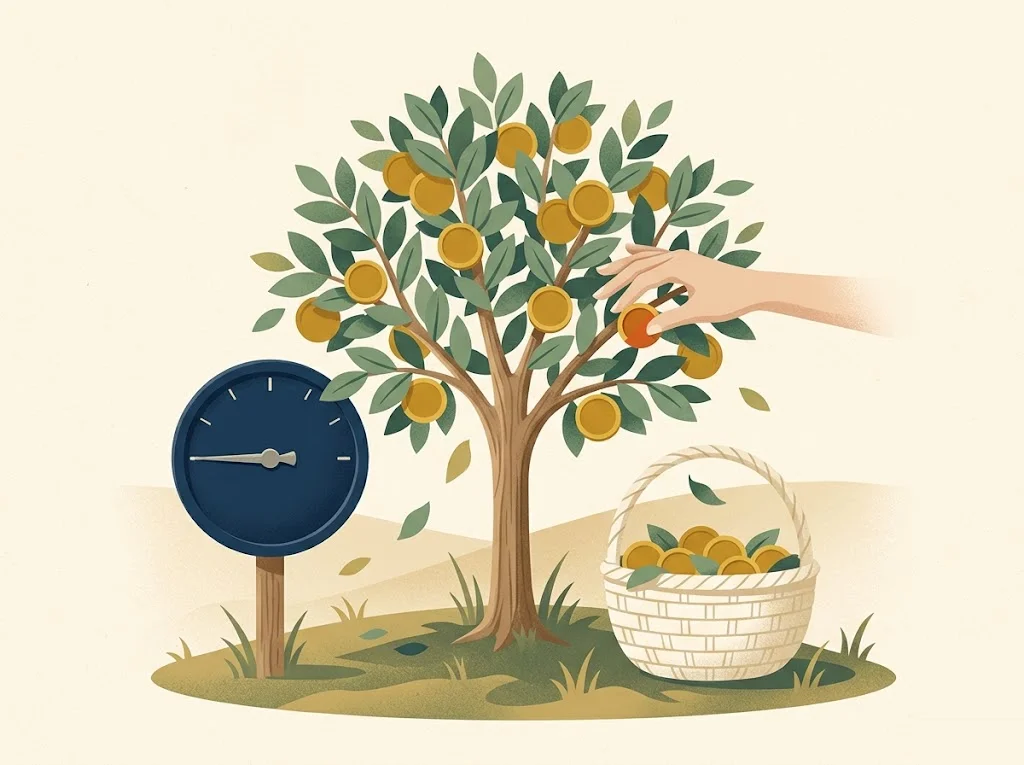
Tax-loss harvesting gets all the press: sell your losers, bank a deduction, trim this year’s bill. The tax code also hides its mirror image, and far fewer investors have heard of it. Tax-gain harvesting means selling investments that have gone up — positions held more than a year, sitting on long-term gains — in a year when your income is low enough that the federal rate on those gains is exactly zero. You sell, you owe nothing, and you can buy the same fund back that afternoon.
The strategy belongs to a specific cast of characters: the engineer on sabbatical, the early retiree bridging the years before Social Security, the gap-year household living on savings, the freelancer whose first year came in lean. Conventional advice says defer gains as long as possible; in a low-income year the smartest move can be the opposite — realize them on purpose while the meter reads zero. It is the strategic mirror of tax-loss harvesting in a taxable brokerage, which pays off in high-earning years; this one only works in the lean ones.
In 2026, a single filer pays 0% federal tax on long-term capital gains as long as taxable income stays under $49,450 ($98,900 married filing jointly). Tax-gain harvesting means selling winners held over a year in a low-income year, paying nothing, and immediately rebuying — the wash sale rule does not apply to gains, so your cost basis resets for free.
How the 0% bracket actually works in 2026
The federal government taxes long-term capital gains on a three-step ladder — 0%, 15% and 20% — and the step you land on depends on taxable income, not gross salary. For 2026, IRS Revenue Procedure 2025-32 sets the 0% bracket at taxable income up to $49,450 for single filers and $98,900 for married couples filing jointly; the 15% rate then runs to $545,500 and $613,700 respectively, with 20% above that. We cover how the 0%, 15% and 20% long-term capital-gains brackets actually work in depth elsewhere; the quick definition lives in our capital gains rate glossary entry.
Two refinements make that ceiling more generous than it looks. First, taxable income is what remains after the standard deduction — $16,100 for single filers and $32,200 for joint filers in 2026, after the One Big Beautiful Bill Act’s amendments and inflation indexing. A single filer with no other income could realize up to $65,550 in long-term gains — $49,450 of bracket plus $16,100 of deduction — and owe the federal government nothing.
Second, the gains stack on top of ordinary income rather than being taxed in isolation. Wages fill the bracket first, the gains pile on above, and only the slice that still fits under the threshold earns the 0% rate — crossing the line is not a cliff, because the portion below stays free and only the excess is taxed at 15%. One hard requirement guards everything: the ladder applies only to assets held more than one year, per IRS Topic No. 409; sell sooner and the profit is taxed as ordinary income. The year-specific angles are in our 0% capital-gains planning brief for 2026.
No wash sale rule, no waiting period
Tax-loss harvesters know the choreography — sell the loser, buy a similar-but-not-identical replacement, wait 31 days before touching the original. None of it applies here. The wash sale rule, codified at section 1091 of the Internal Revenue Code, disallows losses when you rebuy a substantially identical security within 30 days — and by its plain text it covers only losses. Congress never wrote an equivalent rule for gains, because realizing a gain early is normally something the IRS is happy to see.
That asymmetry makes the trade remarkably clean. You can sell your index fund at ten in the morning and rebuy it one minute later. Your market exposure never lapses, yet your cost basis has stepped up to today’s price — every dollar of gain realized at 0% is a dollar that will never be taxed at 15% in some future, higher-income year. It is the closest thing the tax code offers to a free basis reset.
A worked example: the $30,000 year
Consider a single filer — call her Dana — who spent 2026 on a planned career break and earned $30,000 from part-time consulting. Subtract the $16,100 standard deduction and her taxable income lands at $13,900. With the 0% bracket running to $49,450, she has $35,550 of headroom: that much in long-term gains can stack on top of her income before any federal capital gains tax comes due.
In her taxable brokerage sits a total-market index fund bought six years ago for $20,000, now worth $50,000 — a $30,000 unrealized long-term gain. She sells the entire position. The gain stacks on top of her $13,900, bringing taxable income to $43,900, still under the threshold, so the federal tax on the sale is zero. She buys the same fund back the same day, and her cost basis is now $50,000 instead of $20,000.
The payoff arrives later. Suppose she sells for good a few years from now, back in a high-earning job, with the position worth $60,000. Thanks to the harvested basis she reports a $10,000 gain and pays $1,500 at 15%; without the harvest she would have reported $40,000 and paid $6,000. A transaction that cost nothing removed $4,500 of future federal tax. Had her unrealized gain been $40,000 instead, stacking still protects her: the first $35,550 comes out free and the $4,450 overflow is taxed at 15% — roughly $668, not a penalty on the whole amount.
The caveats that actually bite
The federal math is the easy part; the second-order effects are where harvesters get burned. Realizing gains raises your adjusted gross income even when the tax is zero, and several programs key off that figure. The biggest is health coverage: Affordable Care Act marketplace subsidies are calculated from income, so a “free” harvest can shrink the premium credit an early retiree depends on. Anyone on a marketplace plan should model the subsidy effect before selling.
States are the second trap: the 0% bracket is purely federal, and California, notably, taxes capital gains as ordinary income, so a harvest that costs nothing in Washington or Texas can carry a real state bill. Three smaller flags round out the list. The 3.8% Net Investment Income Tax only applies once modified adjusted gross income passes $200,000 single or $250,000 joint — far above 0%-bracket territory, so genuine low-income harvesters can ignore it. Gains realized in a child’s custodial account can trigger the kiddie tax, rerouting the income to the parents’ higher rates. And past 65, extra income can make a larger share of Social Security benefits taxable, quietly eroding the zero.
When the strategy earns its place
Tax-gain harvesting earns a spot on the year-end checklist when a handful of conditions line up, and they align more often than people assume. The assets must sit in a regular taxable brokerage, because retirement accounts do not recognize gains at all. The positions must be held longer than one year, since short-term profits never touch the 0% rate. Taxable income, after the standard deduction, needs to sit comfortably below $49,450 single or $98,900 joint, with daylight left for a meaningful gain. You should be off marketplace subsidies or have priced in their reduction. And the state picture has to be checked separately, because the federal zero says nothing about what your state will charge.
When those boxes do not check — when income is high and a sale would land at 15% or 20% — flip the playbook and look at the loss side instead. The two strategies are complementary bookends: harvest losses in expensive years, harvest gains in cheap ones. Investors who do both treat every December as the same inventory question — which bracket am I in this year, and what does it make free? — and over a working life, the answer compounds.
Sources
- IRS — Rev. Proc. 2025-32 — 2026 long-term capital gains brackets: 0% up to $49,450 (single) / $98,900 (married filing jointly); 15% to $545,500 / $613,700; 20% above.
- IRS — Tax inflation adjustments for tax year 2026 — 2026 standard deduction: $16,100 single / $32,200 married filing jointly.
- IRS — Topic No. 409, Capital gains and losses — holding periods and the capital gains rate structure.
- Cornell Law — 26 U.S. Code § 1091 — statutory text of the wash sale rule, which applies to losses only.
Bracket and deduction figures are the IRS-published 2026 amounts; the worked example is illustrative, and your headroom depends on filing status and income mix.
Quick answers
Is tax-gain harvesting the same as tax-loss harvesting?
No — they are mirror images. Tax-loss harvesting sells positions that are down to capture a deductible loss, and it works best in high-income years when the deduction offsets a high marginal rate. Tax-gain harvesting sells positions that are up, on purpose, in years when your taxable income is low enough that long-term gains fall into the 0% federal bracket. One strategy banks a loss against today's high taxes; the other realizes a gain while the tax on it is zero and resets your cost basis higher, shrinking the taxable gain you will eventually owe later.
Does the wash sale rule apply when I harvest gains?
No. The wash sale rule in Section 1091 of the tax code disallows a loss when you rebuy a substantially identical security within 30 days — and by its own text it applies only to losses. There is no equivalent restriction on gains. You can sell a fund, realize the long-term gain at 0%, and buy the identical fund back the same minute. Your market exposure never changes, but your cost basis steps up to the current price, which means a smaller taxable gain whenever you eventually sell for real.
How much can I harvest at 0% in 2026?
For 2026 the 0% long-term capital gains bracket covers taxable income up to $49,450 for single filers and $98,900 for married filing jointly. Because taxable income is what remains after the standard deduction — $16,100 single, $32,200 joint — a single filer with no other income could realize up to $65,550 of long-term gains and owe nothing federally. With other income, subtract your taxable income from the threshold: someone earning $30,000 has $13,900 of taxable income after the deduction, leaving $35,550 of room at 0%.
Can realizing 0% gains affect my ACA subsidy or other taxes?
Yes, and this is the caveat that catches the most people. The gains are federally tax-free, but they still raise your adjusted gross income, and several programs key off that number. Affordable Care Act marketplace subsidies are tied to income, so a free-at-the-IRS harvest can quietly shrink your premium credit. States tax the gains separately — California treats them as ordinary income. And for retirees, higher income can make more of your Social Security taxable. Run the full picture, not just the federal capital gains math, before you sell.
Educational content only. finbarrow is an independent editorial publication, not a licensed financial advisor, broker, tax preparer, or attorney. Verify rates and terms with the issuer or relevant regulator. See disclaimers and funding disclosures.